Access Will Stop Being The Advantage
Two founders sit across from each other at a co-working space. Same industry. Same stage of company. Same AI subscription.
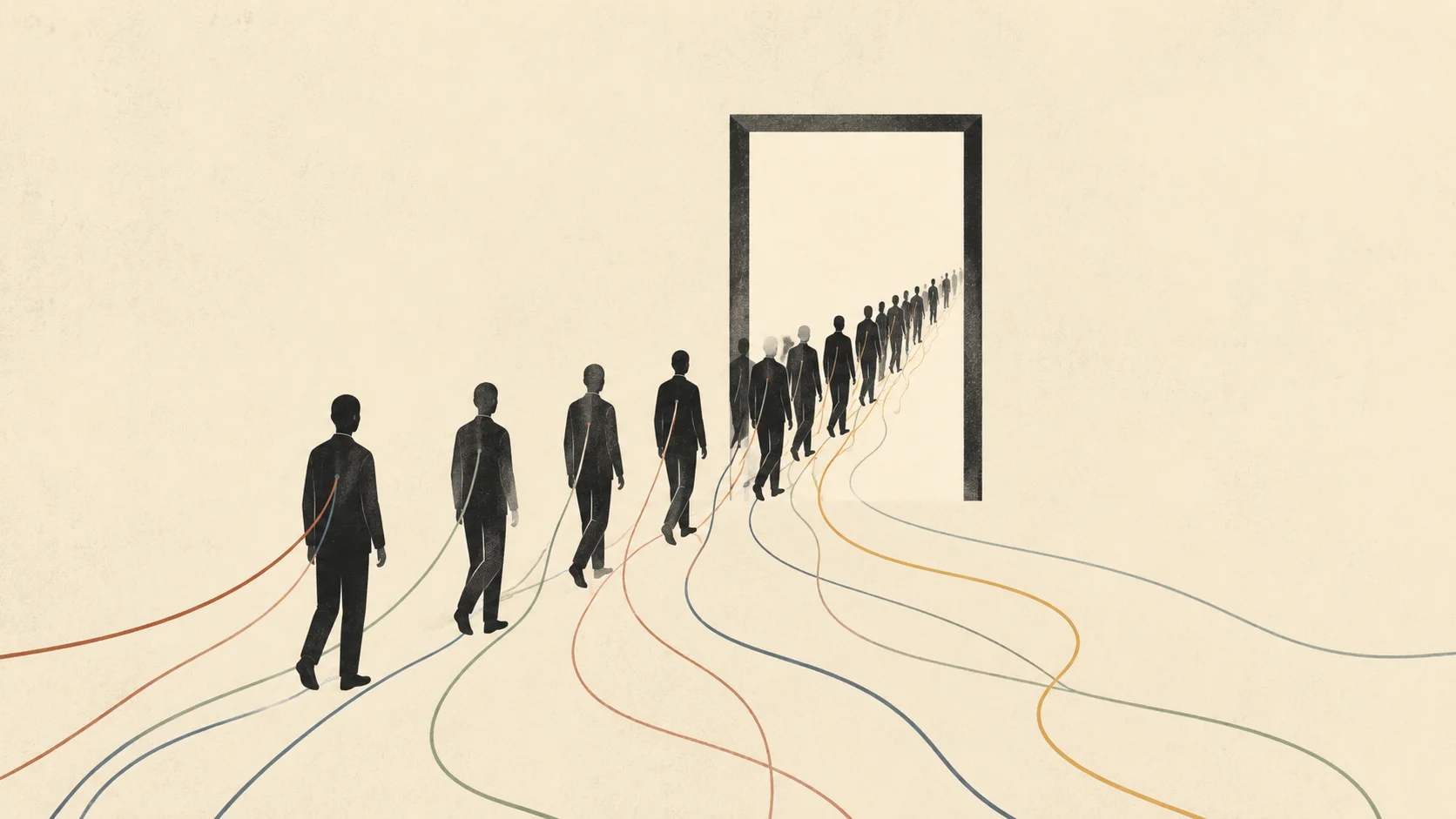
Two founders sit across from each other at a co-working space. Same industry. Same stage of company. Same AI subscription. One pulls up a draft that reads like it came from a strategist who knows her business inside out. Specific. Sharp. In her voice. The other gets a competent, generic summary that could belong to anyone in her industry.
Same model. Same price. Different results by a mile.
The conventional wisdom says the first founder is a better prompter. Maybe she took a course. Maybe she found a template. The conventional wisdom is wrong.
The difference is not the prompt. It is what each person brought to the session. One carried context. The other carried a question. And the machine treated them accordingly.
This is the emerging reality of AI. Access is not the advantage. It is becoming the baseline. What you bring to the tool is what separates useful output from noise.
Access Is Becoming Commodity
The frontier between commercial and open-source AI models gets thinner with every release cycle. Llama, Mistral, and Qwen run on consumer hardware. Ollama, a tool for running models locally, has accumulated more than 169,000 stars on GitHub. Local AI is no longer a hobbyist project. It is a functioning alternative to cloud subscriptions for a growing range of tasks.
The expectation is already forming. Microsoft's 2024 Work Trend Index found that 71% of leaders would rather hire a less experienced candidate with AI skills than a more experienced one without. Access to AI is becoming the baseline employers assume, not the differentiator they reward. Some knowledge workers get capable models through their employer. Some through a twenty-dollar subscription. Some through free, locally-run alternatives that match last year's commercial frontier. The access question is settling.
This means the moat most people think they are building by mastering a specific tool is temporary. The model you use today will be surpassed. The platform you use today may pivot, merge, or disappear. The prompting techniques you learned this quarter will be absorbed into the tool's interface next quarter.
Prompt engineering is a transitional skill. Not worthless, but temporary. The techniques matter now because the tools are immature. As AI interfaces improve, explicit prompting will fade the way command-line proficiency faded for most computer users. What will not fade is the context you carry: your judgment about what good work looks like, your accumulated preferences, your correction history, your understanding of your own domain.
The prompt engineer is a transitional species. The durable asset is the context layer.
The Amplification Problem
Reid Hoffman coined the term "superagency" to describe what happens when millions of people get simultaneous access to AI. His thesis is optimistic: AI as an extension of individual will, amplifying abilities while keeping the human in control.
He is right about the mechanism. Where the picture gets complicated is in what AI amplifies.
AI does not equalize. It amplifies.
Give a structured thinker access to a capable model, and she gets leverage on her clarity. Give a scattered thinker the same model, and he gets faster, more confident versions of his confusion. The tool does not compensate for what the person lacks. It magnifies what the person brings.
Mollick's research makes this visible. The 40% performance gap he measured was not between AI users and non-users. It was between people who had developed judgment about AI's boundaries and people who had not. The consultants who understood the jagged frontier used AI on the right tasks and verified its output on the wrong ones. The consultants who lacked that judgment trusted the model uniformly and performed worse than colleagues who used no AI at all.
Same tool. Same access. Opposite outcomes.
GitHub's Copilot studies tell a similar story. Speed improvements of 30 to 55 percent on coding tasks, depending on the study. But the variance between individual developers is enormous. Some developers integrate Copilot into a structured workflow and see their productivity double. Others accept suggestions uncritically and introduce bugs they spend hours debugging. The tool performs differently because the people using it bring different context.
Dario Amodei, CEO of Anthropic, warned explicitly about a potential "dystopian underclass" of people who opt out of AI-enabled benefits. The framing sounds dramatic. The mechanism is mundane. It is not that people will refuse to use AI. It is that using AI without structured context produces outputs that are technically functional and personally generic. Competent mediocrity at scale.
This is not an elitist observation. It is a diagnostic one. If AI amplifies what you bring, the question is not "Do you have access?" The question is "What are you bringing?"
Most people are bringing a blank text box and a hope.
The Enterprise Already Knows This
Large organizations figured out years ago that raw model access is not enough.
Menlo Ventures' 2024 enterprise AI survey found that 51% of enterprise deployments now use retrieval-augmented generation. Up from 31% the year before. RAG is a technical term for a simple idea: before the AI generates an answer, it retrieves relevant context from the organization's documents, databases, and knowledge stores. The model does not work from general knowledge alone. It works from the company's specific context.
Microsoft built the Semantic Index, an AI-powered knowledge graph that connects emails, documents, calendar events, and chat messages across an entire organization. Microsoft 365 Copilot is the AI assistant Microsoft ships across Word, Excel, Outlook, and Teams. When it answers a question, it draws from that index. It does not start from zero.
Companies build these context layers because they learned something obvious: an AI that knows your business produces better results than an AI that does not. They invest millions in structured context infrastructure because the return is clear and compounding.
Now look at the individual.
Almost no professional invests in giving their AI tools context about themselves. No personal knowledge graph. No structured preference layer. No persistent correction history. No portable set of decision patterns that travels across tools.
Your employer's Copilot knows your company's org chart, its compliance requirements, its project timelines, its communication norms. Your personal AI does not know that you prefer concise language, that you have corrected its tone three times this week, that you changed roles last month, or that the client you are writing for has specific requirements you have explained before.
The enterprise gets compounding value from AI because it built a context layer. The individual does not because no one built them the equivalent.
This is not an access gap. It is a context gap. And it is widening.
What The Edge Actually Is
The edge is not the model. Models will keep improving and prices will keep falling. Everyone will have access to a capable model.
The edge is not the prompt. Prompting is a workaround for a missing layer. As interfaces improve, explicit prompting will shrink.
The edge is not the subscription tier. Premium features become standard features on a predictable cycle.
The edge is owned context.
Your judgment about what good work looks like. Your taste in communication. Your accumulated corrections and preferences. Your workflow memory. Your decision patterns. Your understanding of your domain. All of it structured, persistent, and portable. Carried into every tool you use, not locked inside any one of them.
That is what separates output that sounds like you from output that sounds like everyone. That is what turns a capable model into your model. Not through fine-tuning or custom training. Through context that the person owns and the tool receives.
If context is the edge, the question that follows is immediate: who owns it?
Your platform? Your employer? The model provider?
Or you?
That is the question OwnContext is built around. PersonalOS is the layer you own. A small set of plain-text files: your preferences, your decision patterns, your quality standards, encoded in markdown you can read, edit, port, or delete. Any AI tool can load them. They travel with you when you switch tools, switch jobs, or switch employers. They are the durable asset behind every prompt.
Build your own context layer.
PersonalOS turns your judgment, taste, memory, and workflows into a portable system your AI tools can read.